Showing posts with label breed. Show all posts

Wednesday, September 4, 2013

New Design - Boxer With Natural Ears

New Boxer with natural ears
          In case you haven't heard yet, I had some problems finding a new supplier for the clasps I use in my crate tag. Thankfully after a loooong search I was able to locate a suitable replacement. I bought a ton of them now I'm all fully stocked with a fresh supply of clasps. I had been waiting to release the new Boxer style as soon as I had found a new clasp supplier, now that I have ..........Introducing Boxer with Natural Ears!

          You Boxer lovers will be thrilled to know that you can get all the same colors I currently carry for the cropped ear style now in the natural ears. Once again this was a style with a slight color modification requested by a customer. I am always happy to hear customer requests!
Boxer crate tags with cropped ears. Same colors can now be gotten with natural ears.
          At the time of this post this new style is not yet listed in my shops or on my website, but rest assured I will post them as soon as possible. Not to worry if you don't see them (or any other breed I currently carry) in my shops you are always more then welcome to contact me and request a custom listing. Also don't forget you can also get this new style not only in crate tag form but also as a magnet, ornament, and more.

          Didn't find your favorite breed or color? If you didn't then I would love to hear from you. Because if I don't then there is no telling how long it will take before I'll get around on my own to make it.

Tuesday, July 9, 2013

New Papillon Color Added!

New Papillon in black & white

          Once again thanks to a customer asking for it I can now offer to everyone a new color option in Papillons. For those of you looking for black and white you will be pleased to know that is the new color.

          Currently I only have the new color listed in my Zibbet shop. But rest assured that in time I will get it posted to my website along with my other shops. Of course if you can't wait you are always welcome to contact me and I will get it posted faster.

          If you are looking for something in particular let me know and I will work on adding it to my line of all breed dog crate tags/magnets.

          I thought about working on new breed colors or new breeds but instead I decided to take a bit of a break from that. (That is not to say I wont do it if a customer asks.) In lieu of stitching something new I am finally taking the time to work on the crochet patterns I have bought over the years. My crochet skills aren't very advanced and I haven't crocheted in years but darn it all I want to! (LOL! Heck, I even have knitting patterns sitting around and I don't even know how to knit yet.) I figured if I keep waiting for the perfect time to work on them I will never get my chance. Who knows, if any of my crochet pieces works out perhaps I will end up selling them in one of my shops.

Thursday, April 11, 2013

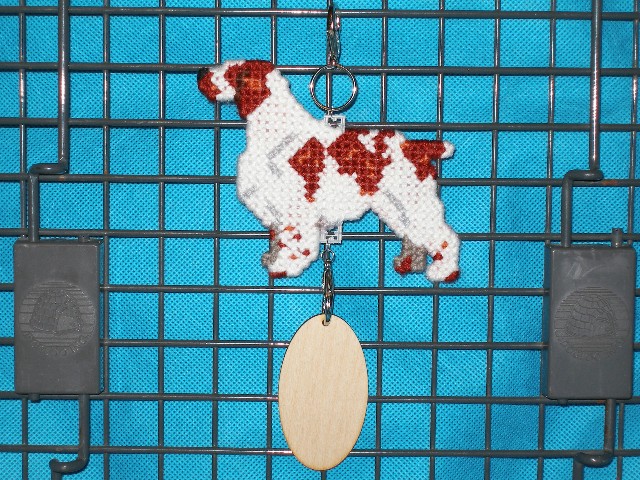
Welsh Springer Spaniel Redesigned and More

NEW pattern for the Welsh Springer Spaniel crate tag or magnet

          It took me almost a whole month to find enough time to rework my new pattern for the Welsh Springer Spaniel. In between orders I like to add new dogs, colors, or re-make old patterns. Normally it doesn't take me quite that long but I had loads of orders that came in and I also had to tweak this pattern three times. But as they say good things come to those who wait.

          The weather forecast for this whole week is off and on rain, what rotten luck. I had hoped to get my outside photos done Tuesday but when I woke up it was lightly drizzling. Fingers crossed that I will be able to get my outdoor shots done soon.

2 NEW colors added to the Havanese

           Thanks to a customer requesting more colors for the Havanese, I can now offer Solid Chocolate and Chocolate/White. That means that you have a total of 5 Havanese colors to choose from, super! But don't forget that I am always open to new color requests.

Sunday, March 17, 2013

A Few of My Favorite Dog Books


I thought I would put together a list of a few of my favorite dog related books.

Good for everyone book short list:
The right dog for you by Daniel F. Tortora, Ph.D.
Dog Owner's Home Veterinary Handbook by Debra Eldridge, Liisa Carlson, Delbert, James Griffon, & Beth Adelman
The Tellington TTouch by Linda Tellington-Jones & Sybil Taylor
Canine Nutrition & Choosing The Best Food For Your Dog Breed Of Dog Each Dog Is Different With Histories And Nutrition Guidelines for 152 Individual Breeds by William D. Cusick
Art of Raising a Puppy by Monks of New Skete
How To Be Your Dog's Best Friend by Monks of New Skete

More advanced Dog book short list:
Pill Book Guild To Medication For Your Dog and Cat by Kate Roby & Lenny Southam
An Eye For A Dog - Illustrated Guild To Judging by Robert Cole
K9 Structure And Terminology by Edward Gilbert, Jr. & Thelma Brown
The New Dogsteps: A Better Understanding Of Dog Gait Through Cineradiography by Rachel Page Elliott
Successful Dog Breeding by Chis Walkowicz & Bonnie Wilcox
The Dog Breeder's Guild To Successful Breeding And Health Management by Margaret Kustriz
Breeding A Litter The Complete Book Of Prenatal and Postnatal Care by Beth J. Finder Harris


Don't limit yourself to this list, this is just a tip of the iceberg of great dog books. Look into positive training methods, natural dog foods, holistic healing, and more. Now get out there and read!

Saturday, March 2, 2013

Havanese Lovers Now Have More Choices


          This year I had large orders for Havanese crate tags and a request for new colors, I love requests. As you Havanese lovers already know I have had the black and white color for quite some time now. I am happy be now present two, yes that's right, count'em two new colors! Introducing the red sable & white and gold.

          I am not a expert in every dog breed, so I am very appreciative to those who are and willing to help give me feedback. It makes for a better representation of breed and/or color.

          Don't forget all my single sided crate tags now come with the option of getting them in a magnet. Cool, right?!

          When I create a new pattern I first like to do research, this is the most important step to getting the dog breed right. Then I will do a preliminary sketch, followed by selecting yarns I think will work best. The limited yarn pallet I have to work with can be frustrating at times, some shades just don't have the gradation I need. This was the case for the gold Havanese, it made for a challenge that I was determined to raise to.


          Some patterns go so smoothly, while others like the gold color can put up a fight. Just because something looks good in your mind's eye or on paper doesn't always translate to the yarn when stitched. It was on the fourth time stitching (and a good long break in between) did I finally nail it. Whew! It may have been hard work but the reward of a lovely finished piece is sooooo worth it!

Thursday, January 17, 2013

New Releases - Miniature Schnauzer with Undocked Tail and More

Miniature Schnauzer with natural ears and tail.
           It is that time again my friends, so without any further ado here are my first releases of 2013! They are Miniature Schnauzer with natural (or full) ears and tail, a new color for the Pomeranian, a new look and color for the Nova Scotia Duck Tolling Retriever, and Poodle in the sporting clip.

          I had a customer recently contact me about placing an order for a Miniature Schnauzer. The pattern I had was for the American version with cropped ears and a docked tail, but in many countries they no longer crop or dock. So with this being the case for this customer I was more than happy to oblige and add this new pattern. If you are looking to place an order for a dog without a docked tail just send me an email so I can include that dog to my line of needlepoint dogs.

Pomeranian, New color


          The Pomeranian now has two color options, yay! Most of the new items add are customer requests, so don't be shy and tell me what you want to see.

Nova Scotia Duck Tolling Retriever


          The current pattern I have for the Nova Scotia Duck Tolling Retriever had its tail down, the new pattern now features an alert tail. At the moment I will offer both patterns. However, if customers seem to only like the new pattern then I will discontinue the old. What do you think, do you like the new pattern over the old tail down look? Leave me a comment below and tell me about it.

Standard/Miniature Poodle in a sporting clip

          And my last introduction is the Poodle in a sporting clip. I think this look is going to be very popular with most Poodle owners.

          Most of these new piece can be found in my Etsy shop, I still need to list the new Pomeranian color there so please check back later or send me an email. I will be getting these new items up on my website and in my other shops as soon as I can.

Wednesday, November 21, 2012

Australian Cattle Dog

Click to see all my Australian Cattle Dog items for sale.

Find out everything you ever wanted to know about the Australian Cattle Dog, all in one convenient place right here on my blog. I will be featuring other dogs, so continue following my blog to read all about your favorite breeds.   


Other Names/Nicknames:                ACD, Australian Heeler, Australian Queensland Heeler, Blue Heeler, Blue Heeler, Heeler, Queensland Blue Heeler, Queensland Heeler, Queensland Red Heeler, and Red Heeler.

Country of Origin: Australia

Herding Group     (Pastoral Group, Cattledogs)

Purpose of Breed:               Cattle herder and livestock guardian.

Recognized By:    American Kennel Club in 1980
Canadian Kennel Club in NOT AVAILABLE
Fédération Cynologique Internationale in NOT AVAILABLE
Kennel Club in 1985
United Kennel Club in 1985

Population Scarcity:           Not vulnerable

AKC Ranking in 2010: 64th

Life Expectancy: 10-15 years

Weight: approximately 33-50 lb (15-23 kg)
Bulk/Substance: middle
A compact and well-muscled built dog with the appearance is that of power and balance, conveys agility, strength and endurance.

Height:  Male 18-20 inches (46-51 cm)                             Female 17-19 inches (43-48 cm)
Size:       medium

Proportion: is slightly longer than tall, as 10 is to 9

Color:     Blue - The color should be blue, blue-mottled or blue speckled with or without other markings. The permissible markings are black, blue or tan markings on the head, evenly distributed for preference. The forelegs tan midway up the legs and extending up the front to breast and throat, with tan on jaws. The hindquarters tan on inside of hind legs, and inside of thighs, showing down the front of the stifles and broadening out to the outside of the hind legs from hock to toes. Tan undercoat is permissible on the body providing it does not show through the blue outer coat. Black markings on the body are not desirable.

Red Speckle - The color should be of good even red speckle all over, including the undercoat, (neither white nor cream), with or without darker red markings on the head. Even head markings are desirable. Red markings on the body are permissible but not desirable.

The ACD's coloration should not to be confused with merle as it is the result of the ticking gene. Ticking which is the presence of color in the white areas with the flecks of color being the same as the basic color of the dog, though the effect depends on other genes that will modify the size, shape and density of the ticking.

Coat:      The coat is smooth, a double coat with a short dense undercoat. The outer-coat is close, each hair straight, hard, and lying flat, so that it is weather resisting. Under the body, to behind the legs, the coat is longer and forms near the thigh a mild form of breeching. On the head (including the ears), to the front of the legs and feet, the hair is short. Along the neck, it is longer and thicker.  A coat either too long or too short is a fault. Average hair length on the body should be from approx. 1-1 1/2 inches (2.5 to 4 cm) in length. The dog should be shown in natural state.

Trimming/Clipping Required: low to none
Grooming: Brush weekly; clean ears; clip nails
Time Spent Grooming: once a week for about 10 minutes, more when shedding.

Shedding: BIG time seasonally.

Basic Grooming Tools Needed:        Slicker brush
Pin brush
Comb
Scissors
Nail clippers & Styptic powder

Temperament:      ACD are determined, equable temperament, courageous, trustworthy, with an independent streak. With absolute devotion to duty, making them loyal and a self-appointed guardian to it's owner, his herd and his property. While naturally suspicious and wary of strangers, the breed bonds closely to its family. However, the owners must establish themselves as the pack leader. Early socialization to both a variety of people and situations is recommended. Because of their level of devotion to their owners will typically result in the dog being never to far from the owner's side. They can be aggressive with other animals but respond well to familiar dogs as long as there is an established pecking order. They can bite if "harshly treated" but are amenable to proper handling. To clear up some misconceptions, a red ACD is not a Dingo and there is no difference in temperament between blue and red dogs.

Breed Characteristics:      The ACD is ever alert, watchful, and quick intelligence. Protective of its herd and property. They are cattle heading extraordinaires, ready, willing, and tireless to work all day. ACD work independently and often has to think for itself, moving stubborn cattle by coming in low from behind, biting the hock of the weight-bearing leg, and ducking to avoid the kick that often follows. They are able to easily control and move cattle in wide open or confined areas and on any terrain. Stubborn cows don’t discourage this breed, in fact they just become more determined to get the job done.

Best for: experienced owner, lots of attention, structured training, active owners, herders, and other high dog activities.

Not for:  inactive people, first-time dog owners, children under five years, submissive people, apartments, those lacking time, and never as a back yard dog.

Sociability with Other Dogs:            Can be aggressive especially if it feels challenged or threatened. dominant; accept amiable dogs, preferably of opposite sex

Sociability with Strangers:               most are mildly friendly ("reserved", "takes time to warm up to", "naturally cautious/suspicious") with strangers.

Sociability with Children:                 good with older, considerate children; good if raised with them; driving instinct might transfer to kids, particularly those running and screaming.

Watchdog Ability: alert (efficient)
Protection Ability: natural - accepting
natural- (usually holds intruders at bay by barking and growling, but has to be trained to attack.)
average- (gets confused with intruders, barking and growling indiscriminately at anyone. Without training it would be an undependable guard dog.)
accepting- (usually greets most strangers as friends. Occasionally encounters a stranger whom it fears.)

Sociability within Family:                  one-family or one-person dog. Extremely loyal and devoted to his family, often referred to as "velcro dogs". Some will bond more closely to one person while some bond closely to the whole family. Loving and playful family pet.  They live and breathe to make their people happy," obedient yet bold". Expect your ACD to constantly test the rules, probe for the limits, and to test what is and what is not acceptable. But also expect your ACD to truly care and be devoted to your welfare at all times. They are loyal and biddable, and respond well to training.

Indoor Activity:    moderate
Outdoor Activity: very active
Exercise Required: high (up to 1 hour per day)

Ease of Training: med

Possible Health Problems:                Accidental Injury, Arthritis, Deafness (in either one or both ears), Elbow Dysplasia, False Pregnancy, Glaucoma, Hip Dysplasia, Infertility, Lens Luxation, OCD (osteochondritis dessicans), PRA (progressive retinal atrophy), Pyometra, and Spondylosis.
A relatively healthy breed but that is not to say it is free of health concerns.

Possible Behavior Problems:            ACDs does every thing with force, are high energy, intently focused dogs and want to be active and busy most, if not all, of the time. This energy must be given an outlet or you will quickly end up with problems. Bored, they will find ways to entertain themselves, usually doing something you will not like. A tired cattle dog is a good dog.

They are an intently focused breed, everything they do is immensely important, from their point of view, and they always do it to the best of their ability. If they are doing good things then life is wonderful, but if they are doing something bad, you can count on it being horrid.

Without their own cattle, most will find other things to herd such as other pets, toys, kids, people, and anything that moves like lawn mowers, vacuum cleaners, and vehicles. This behavior can range from amusing, annoying, to outright dangerous. Biting at the ankle or hind leg is instinctive. This means they have a strong tendency to bite people, even just in play. This must be strongly curtailed from day one.

Part of their desire to herd comes from a strong prey drive, which is the drive to catch and kill small game. They can easily become cat, squirrel, or other small animal-killers. Teaching your dog to obey you and not chase squirrels can save your dog's life, especially when the dog decides to dart across a road in pursuit of something to chase. Most ACDs are fine with other species IF THEY ARE RAISED WITH THEM.

ACDs instincts make them a "mouthy" breed. Most will chew anything in sight if this is not directed toward acceptable chew toys. Many will even try to gently chew on people as a sign of affection.

Extra Information:               ACD are supposed to have a tail. A tail is described in both the American and Australian breed standards. These dogs are true athletes and use their tail as a rudder when making sudden changes of direction, whether while herding cattle, doing agility, or playing in the back yard. While ACDs generally work silently, they will bark in alarm or to attract attention. They have a distinctive intense, high-pitched bark which can be particularly irritating. Implicit devotion to duty. Always alert, extremely intelligent, courageous. They are a superb worker with remarkable reasoning power.

History: Thomas Hall developed ACDs in Australia in the mid to late 1800. He had imported some Smooth-coated Blue merle Highland Collies from Scotland, known by some as Welsh Heelers. These dogs were forceful heelers but barked at the head which was not suitable for the wild cattle, and they lacked the endurance and heat resistance needed for the climate. Hall crossed his Collies with selected dingoes he had tamed to combine the working ability of the Collie with the physical type, heat resistance, and reputed silence of the Dingo. During the next thirty years, the Halls Heelers, as they became known, were used only by the Halls. Given that they were dependent on the dogs, which gave them an advantage over other cattle breeders, it is understandable that the dogs were not distributed beyond the Hall's properties. It was not until after Thomas Hall's death in 1870, when the properties went to auction was Halls Heelers became freely available.

It was later in 1893 that Robert Kaleski took up the pure Hall dogs joining G.W. and H. Bagust, C. Pettitt, J. Brennan, and A. Davis, (the son of Fred Davis, who brought the first pair of Hall's dogs to Sydney around 1870), and others such as J. Rose who were actively breeding at the time. This core of men saved the breed as we know it today as it would not have survived due to indiscriminant crossing with various farm dogs had they not taken steps to preserve it.

Because the Hall line was the result of direct crosses of Highland Collies and Dingoes, a distinctive type was not yet fixed. It seems that from the first evolution, the Blue Heeler was identifiable only by working ability and similar coloration. There is still some disagreement as to the actual breeds that were later crossed into the ACD, among them are the Dalmatian, Australian Kelpie, Bull Terrier, and others. ACDs are born white, which is possibly inherited from the Dalmatian. Kaleski himself does not reveal the Kelpie cross until 1930. A few years later, he states that such a cross was necessary to provide the cattle dog with heading instinct. The resulting dogs threw true to type and had unique markings indicating the strain and the abilities attendant in each strain

Australians owe a great debt to all the persons involved in the development of the Australian Cattle Dog, for without it the beef industry of Australia would undoubtedly have had great difficulty in developing into the important industry that it has become.

The standard for the ACD was drawn up by Mr. Robert Kaleski in 1902 and was based around the Dingo type. Kaleski submitted his standard to the Cattle and Sheep Dog Club of Australia, and the original Kennel Club of New South Wales for their approval. The standard was approved in 1903. The ACD was accepted for registration by the American Kennel Club as of May 1, 1980, and became eligible to be shown in the Working Group as of September 1, 1980. It was transferred to the Herding Group when that was formed, effective January 1, 1983.

Collar Length: NOT AVAILABLE
A collar should ride high on your dog's neck without fitting too loosely as to slip over his head, nor to tightly as to restrict breathing or cause coughing. It should be snug with enough room to fit two fingers between dog's neck and collar. Check collar size frequently on growing puppies. Use a tape measure to measure dog's neck and then add on 2-3 inches (5-7 cm).
Collar Width:       1/2-5/8 inches (1-1.6 cm) width is best for puppies and small dogs.
5/8-3/4 inches (1.6-1.9 cm) width is best for small to medium dogs.

Leash Length:      that depends on use of the leash. A good all around and obedience leash is 6 feet (2 meters).
Recommended Leash Width: NOT AVAILABLE

Crate Size: about a 36 inches (91.44 cm) tall crate.
The best way to determine the correct size kennel for your dog is to measure your pet. Measure from the floor to the top of your dog's shoulder, and add 3-6 inches (8-15 cm); this is the minimum cage height. Then measure from the dog's head to the base of his tail, and add 3-6 inches (8-15 cm); this is the minimum cage length. If the kennel is going to have a 'permanent' place in your home, you will want to make sure that your dog can comfortably stand, sit, turn around, and lie down in it.

Dog Bed Size:      Rectangular - 24 x 42 inches (60.96 x 106.68 cm)
Oval - 24 x 42 inches (60.96 x 106.68 cm)
Round - 42 inches (106.68 cm)
The best way to measure your dog for a bed is when dog is laying down. Measure from base of tail to tip of nose, and add a minimum of 12 inches (30 cm). For bolster or snuggle style beds, add a minimum of 5-7 inches (13-18 cm).

Useful Breed Links:           American Kennel Club (AKC)

Kennel Club (KC)


Stop by my store on Etsy to see my Handcrafted Australian Cattle Dog art or check out the many other dog breeds I carry and more. Remember if you don't find what you are looking for just ask, I am always very happy to answer questions.

CAN YOU HELP? - In the sections that say 'NOT AVAILABLE,' I need help finding the correct information to fill in those blanks. If you know the answer please leave your response in the comments section below, thank you.

MAKE YOUR DOG FAMOUS - I would like to add some dog photos to this breed profile. If you would like me to use your dog's photo contact me or leave a comment below. I will be more than happy to give you and your dog credit in the photo's caption.

Thursday, December 8, 2011

Improved Bearded Collie & Borzoi Designs


          As time progresses on and I look back at some of my very first dog breed patterns, I realize that some can do with some improving. My skills and eye for how I create my all breed dog items have matured over the years. I know that there are many more dog breeds and colors I have not yet gotten to but I just can not help but want to revisit some of the earlier designs. It is not that I think they are bad, it is just I have this nagging compulsion that says "I bet I can do that even better".

          In between filling orders (which recently has left me very little down time) I managed to rework the Bearded Collie and Borzoi. More times then I can count did I have to either stop in the middle of sketching or stitching both of these dogs, but I somehow found enough time to get them done.


          The Bearded Collie proved to be the easier of the two for me, although I did have to only rework the size of the head from my first attempt at redoing this design. Unlike drawing or painting, needlepoint on plastic canvas deals with squares and it can prove to be problematic at times.

         The Borzoi on the other hand was giving me quite the challenge, mainly becuase of the head. I think I tried six different head versions before I ended up with the one you see now. I am so very happy with the way it looks that now I may redo a few of the other sighthounds. But of course that is all for another time.

          Like one of these or any of my other dogs but you don't see your color, then please contact me. I am more then happy to add new breed colors.

Monday, November 21, 2011

Half Price on all One-Of-A-Kind Dog Ornaments

American Cocker Spaniel sale ornament
          I am running a sale on all my one-of-a-kind dog breed ornaments, they are now half off their original price. The sale runs until the end of November or until they sell out. Hurry limited supplies available, once they sell out they wont be back again.

          They can be used as a Christmas or an everyday ornament. You can easily hang them anywhere, and with them being stitched with the same image on both sides they can enjoyed from different angles.

          If you do not find your favorite breed I also carry a regular line of Everyday Ornaments.

Wednesday, October 12, 2011

New design - introducing the Leonberger


          That is right, it has been a while since the last time I added a new breed. Most recently I have added new colors to breeds I already have and I have even redid a few older pattens. So I think it is about time for a new breed and here it is the Leonberger.

          One of my more recent repeat buyers asked me about making the Leonberger. Of course I am always very happy to accommodate requests but I was excited to be working on this particular breed. I keep a growing list of breeds and colors that I would like to make. I am hoping someday to have all the breeds and colors done but in the meantime I have my list. The Leonberger just happened to be one of the breeds at the top of my to-do list. I just love the rich colors of this breed's coat, so beautiful.


          The size of the Leonberger is 3 5/8" x 5" or 9.20 x 12.7 cm. I currently have the single side crate tag listed on ArtFire and very soon I will get the ornament listed as well. Any time you are looking for a breed, item, color, etc please contact me if you don't find what you are looking for. It could be I just don't have it listed as of yet.


          If there is a dog breed or color that I don't have that you would like to see me carry please leave me a comment below. I always enjoy hearing input from other dog lovers. Are you having a hard time finding a "hard to find" color for your favorite breed? I would love to be the one place to offer that color. So speak up and tell me about it.

Wednesday, August 24, 2011

What Dog Breed Should I Make Next?


          I am looking for your input! I want you to tell me what breed of dog would you like to see me make next. You can look through the breeds I currently make by clicking here. Do you like Herding breeds, Sporting breeds, or perhaps Toy breeds? It can be any AKC recognized breed from any group or any breed of dog recognized by any other registry. If the dog breed you pick comes in multiple colors please also include the color you would most like to see.

          On September 19, 2011 I will pick a dog from your suggestions. You can suggest as many different breeds as you like but I ask that you please post each breed separately. If by the Sept. 19th I don't have at least 5 different people's suggestions to pick from I will extend the search till the end of September.


Will your favorite dog breed be next? It could be!

Monday, July 11, 2011

3 New Great Dane Colors have been added

          When I started out stitching up a new color to add to the other 3 previously ones, I hadn't planed on finishing off all the Great Dane colors. But once I created and stitched the pattern for the harlequin color I figured why not! So I whipped up the black and blue as well. The great thing about doing it this way I was able to take a photo of all 6 crate tags together.

          Making the pattern for the harlequin color was a bit tricky. I had to re due it a few times because the torn patches where coming out more like spots. The plastic canvas put up a fight but in the end I triumphed and the end result proves it.

          I am so excited that the Great Dane is finished and all the colors for this breed are complete. It is a little goal compared to all the breeds and colors I still need to get through, but its a good feeling to be a step closer. Now on to the next!!

Thursday, June 30, 2011

American Water Spaniel

Click to see all my American Water Spaniel items for sale.

Find out everything you ever wanted to know about the American Water Spaniel, all in one convenient place right here on my blog. I will be featuring other dogs, so continue following my blog to read all about your favorite breeds.   


Other Names/Nicknames: AWS

Country of Origin: United States of America

Sporting Group           (Gun Dog Group, Water Dog)

Purpose of Breed:      Gundog; a competent retriever also doubles as a flushing spaniel. Like many of the spaniel breeds, it hunts both feather and fur (and even fish) with equal enthusiasm. Hunts on land but excels in water.

Recognized By:          American Kennel Club in 1940
Canadian Kennel Club in NOT AVAILABLE
Fédération Cynologique Internationale in NOT AVAILABLE
Kennel Club in NOT AVAILABLE
United Kennel Club in 1920

Population Scarcity:   Rare but not vulnerable

AKC Ranking in 2010: 143rd

Life Expectancy: 10-15 years

Weight:           Male 30-45 lb (13-20 kg)                    Female 25-40 lb (11-18 kg)
Bulk/Substance: middle
A solidly built and well-muscled dog full of strength and quality. The breed has as much substance and bone as necessary to carry the muscular structure but not so much as to appear clumsy.

Height: 15-18 inches (38-46 cm)
Size:    small - medium

Proportion: is slightly longer than tall, not too square or compact.

Color:  either solid liver, brown or dark chocolate. A little white on toes and chest permissible.

Coat:   can range from marcel (uniform waves) to closely curled. The amount of waves or curls can vary from one area to another on the dog. It is important to have undercoat to provide sufficient density to be of protection against weather, water or punishing cover, yet not too coarse or too soft. The throat, neck and rear of the dog well-covered with hair. The ear well-covered with hair on both sides with ear canal evident upon inspection. Forehead covered with short smooth hair and without topknot. Tail covered with hair to tip with moderate feathering. Legs have moderate feathering with waves or curls to harmonize with coat of dog. Can be shown in natural coat or coat may be trimmed to present a well-groomed appearance; the ears may be shaved; but neither is required.

Trimming/Clipping Required: some
Grooming: Brush weekly; clip excess hair from feet, topknot and top of ears; clean ears
Time Spent Grooming: once a week for about 30 minutes.

Shedding: light, but constant (ordinary).

Basic Grooming Tools Needed:        Slicker brush
Pin brush
Comb
Scissors
Nail clippers & Styptic powder

Temperament:            Their demeanor indicates intelligence, eagerness to please and friendliness. They are an excellent sporting dog that also fits suitably into the family circle, as they do not have to hunt to be happy. AWS loves their daily exercise, but equally enjoys just hanging out with his family. The American Water Spaniel is an efficient watchdog and protective of its owner. They can become more attached to the alpha person in the house. AWS will think of young children as kennel mates until they grow up. In old age, some AWS may become temperamental.

Breed Characteristics:           As a breed that is intelligent and likes to please, they respond well to non-heavy handed consistent and fair training. Although AWS train quickly they may not do as well with rote training drills, having variety in the training process will help keep them from becoming bored.

An AWS needs to be housed with the rest of the family as this breed excels when given proper attention and made to be a part of the family. Therefore, they should not be housed outside in a pen or yard except by an experienced trainer or breeder that knows how to properly raise a dog in such an environment.

As a hunting dog they are a busy and tireless worker with an affinity for water. They have a great energy and eagerness for the hunt yet controllable in the field. The American Water Spaniel is an all-around hunting dog capable of spending a day in the field or sitting patiently in a duck blind. As a retriever, the American Water Spaniel is more suited to working marshes, and bodies of water for waterfowl. They mark fallen game well and retrieve with great enthusiasm. The AWS has a great nose that makes the breed especially adept at tracking a wounded bird or chasing down a running pheasant. While the breed's manner of flushing is somewhat soft compared to other spaniels, it will get the job done.

Best for: upland birds or waterfowl hunters, active families, lots of attention.

Not for: inactive people, first-time dog owners, the yard-proud, those lacking time.

Sociability with Other Dogs: some can get scrappy with strange dogs.

Sociability with Strangers:     most are mildly friendly ("reserved", "takes time to warm up to", "shy") with strangers.

Sociability with Children: good with older, considerate children.

Watchdog Ability: alert (efficient)
Protection Ability: natural - accepting
natural- (usually holds intruders at bay by barking and growling, but has to be trained to attack.)
average- (gets confused with intruders, barking and growling indiscriminately at anyone. Without training it would be an undependable guard dog.)
accepting- (usually greets most strangers as friends. Occasionally encounters a stranger whom it fears.)

Sociability within Family: small-family or one-person dog.

Indoor Activity: active - moderate
Outdoor Activity: very active
Exercise Required: medium (up to 30 minutes per day)

Ease of Training: high

Possible Health Problems:    Allergies, Cancer, Cardiac Abnormalities, Cataracts, Detached Retina, Diabetes, Epilepsy, Follicular Dystrophy, Hip Dysplasia, Hypothyroidism, Patellar Luxation, and PRA.
No one health issue plagues this breed but neither is it free of health concerns.

Possible Behavior Problems:            barking, irritable snapping. roaming, and whining. Certain specimens may drool, snore, and have a strong coat odor.

Extra Information:     thorough, eagerness may render him overanxious, they mature slowly, good swimmer, great hunter, desire to please, a litter size of 4-6 puppies. The AWS is likely one of the contributing breeds to the Boykin Spaniel.

History:          Sometime in the 1800's in the Fox and Wolf River Valley region of East-Central Wisconsin of the United States, market hunters set about making a sturdy smaller retriever. They needed a dog that was smaller in both size and weight to fit in the small skiffs and canoes that the hunters used. The new breed had to have a coat that had some waterproofing quality that would allow the dog to work tirelessly in the icy rivers, lakes, and cold marsh. The dog needed to be built to swim for long periods of time but also need to be functional on land

The origin of the American Water Spaniel is something of a mystery as there is no documentation as to the specific breeds that were used to develop it. AWS scholars do agree that the Curly-Coated Retriever, Irish Water Spaniel, English Water Spaniel (extinct), Flat-Coated Retriever, Field Spaniel, Tweed Water Spaniel (extinct), and possibly the Chesapeake Bay Retriever were used. What doesn't seem to be agreed upon is if all or only some of these breeds were used to create the American Water Spaniel.

In 1920, the United Kennel Club formally recognized the American Water Spaniel as a purebred dog, thanks to the help of a Wisconsinite by the name of Doc Pfeifer. Unfortunately, this tenacious little hunting dog never really gained the popularity as some of the other hunting breeds have over the years. Today it remains mostly as a bit of a "forgotten" breed except by its staunched supporters and by the people of its birthplace. In 1985, Wisconsin declared the American Water Spaniel its state dog.


Collar Length: NOT AVAILABLE
A collar should ride high on your dog's neck without fitting too loosely as to slip over his head, nor to tightly as to restrict breathing or cause coughing. It should be snug with enough room to fit two fingers between dog's neck and collar. Check collar size frequently on growing puppies. Use a tape measure to measure dog's neck and then add on 2-3 inches (5-7 cm).
Collar Width:              1/2-5/8 inches (1-1.6 cm) width is best for puppies and small dogs.
5/8-3/4 inches (1.6-1.9 cm) width is best for small to medium dogs.

Leash Length:            that depends on use of the leash. A good all around and obedience leash is 6 feet (2 meters).
Recommended Leash Width: 5/8-3/4 inches (1.6-1.9 cm) width

Crate Size: about a 30 inches (76 cm) tall crate.
The best way to determine the correct size kennel for your dog is to measure your pet. Measure from the floor to the top of your dog's shoulder, and add 3-6 inches (8-15 cm); this is the minimum cage height. Then measure from the dog's head to the base of his tail, and add 3-6 inches (8-15 cm); this is the minimum cage length. If the kennel is going to have a 'permanent' place in your home, you will want to make sure that your dog can comfortably stand, sit, turn around, and lie down in it.

Dog Bed Size:            Rectangular - 24 x 42 inches (61 x 107 cm)
Oval - 24 x 42 inches (61 x 107 cm)
Round - 42 inches (107 cm)
The best way to measure your dog for a bed is when dog is laying down. Measure from base of tail to tip of nose, and add a minimum of 12 inches (30 cm). For bolster or snuggle style beds, add a minimum of 5-7 inches (13-18 cm).

Useful Breed Links:  American Kennel Club (AKC)
                                   American Water Spaniel Club (Parent club)
                                   The American Water Spaniel Field Association, Inc.
                                   Breed Rescue
                                   Fédération Cynologique Internationale (FCI)
                                   Canadian Kennel Club (CKC)
                                   Kennel Club (KC)
                                   Untied Kennel Club (UKC)
                                   Breed information on Wikipedia
                                   More breed information  


Stop by my store on Etsy to see my Handcrafted American Water Spaniel art or check out the many other dog breeds I carry and more. Remember if you don't find what you are looking for just ask, I am always very happy to answer questions.

CAN YOU HELP? - In the sections that say 'NOT AVAILABLE,' I need help finding the correct information to fill in those blanks. If you know the answer please leave your response in the comments section below, thank you.

MAKE YOUR DOG FAMOUS - I would like to add some dog photos to this breed profile. If you would like me to use your dog's photo contact me or leave a comment below. I will be more than happy to give you and your dog credit in the photo's caption.